

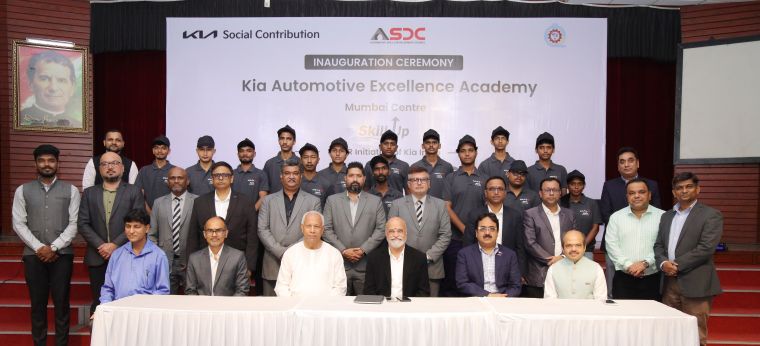
Kia India, a leading mass-premium automaker, in partnership with the Automotive Skills Development Council (ASDC), on Oct 19 inaugurated an automotive skill development centre at Don Bosco Industrial Training Institute (ITI), Kurla, Mumbai. The inauguration marks the first under a four-centre skill development initiative aimed at training 360 candidates across Faridabad, Mumbai, Bengaluru and Kolkata. Supported under Kia India’s Corporate Social Responsibility (CSR) programme, the initiative seeks to strengthen youth employability and contribute to the development of a skilled, industry-ready workforce for India’s evolving automotive ecosystem.
The initiative includes Kia India-exclusive centres in Faridabad and Mumbai, while the centres in Bengaluru and Kolkata will also accommodate other automotive manufacturers. Implemented as a pilot, the programme aims to establish a scalable skilling framework that can potentially be extended to additional locations.
The Mumbai centre, in partnership with Don Bosco ITI, will train 150 candidates across three job roles: Four-Wheeler Service Technician, Automotive Service Advisor and Automotive Sales Executive. The programme targets 150 candidates each in Faridabad and Mumbai, and 30 each in Bengaluru and Kolkata. The training programme will be offered free to participating candidates, combining classroom instruction, hands-on practical learning and on-the-job exposure.
The three training pathways will equip candidates with capabilities spanning vehicle maintenance, diagnostics and repair, customer advisory, engagement and automotive sales. The programme seeks to address the automotive industry’s evolving workforce requirements amid changing vehicle technologies, digitalisation and customer expectations.
Mr. Vinkesh Gulati, Chairperson, ASDC, said, “India’s automotive industry is witnessing significant growth and transformation, resulting in an increasing requirement for skilled professionals across technical and customer-facing functions. Through this partnership with Kia India, we aim to bridge the prevailing skills gap by delivering industry-relevant training closer to aspiring professionals. The programme will prepare candidates for practical workplace requirements while supporting the sector’s transition towards a more technology-led and customer-centric ecosystem.”