

Two decades after Jamia Millia Islamia discontinued its elected students’ union, a hunger strike has revived the question of democratic representation on campus. The controversy comes as Delhi University and Jawaharlal Nehru University continue to hold student elections, Aligarh Muslim University prepares to restore its polls, and other institutions experiment with alternative council structures.
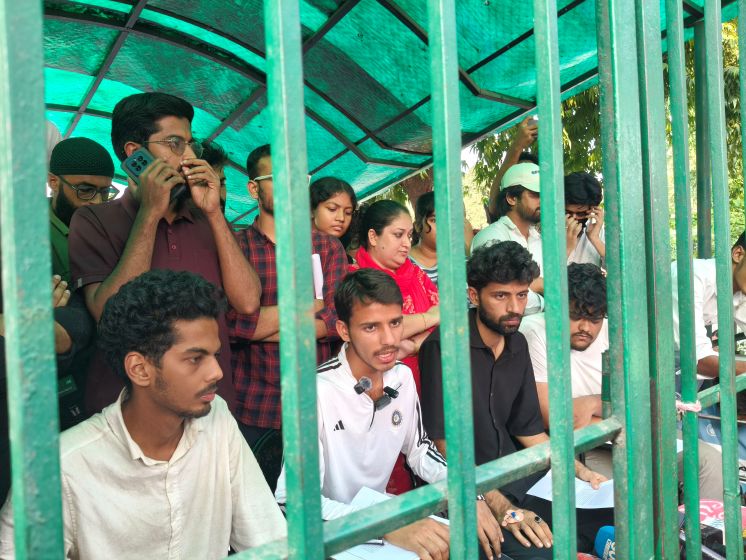
Jamia Millia Islamia (JMI) has constituted a high-level, seven-member committee to engage with protesting students, examine their demands and suggest steps to restore peace and normalcy on campus. The university announced the committee on October 19, as an indefinite hunger strike demanding the restoration of the Jamia Millia Islamia Students’ Union (JMISU) entered its second week. The formation of the committee marks an administrative response to the agitation, but does not, by itself, constitute a commitment to hold elections.
The protest began on October 12 with a small group of students and gained momentum as the confrontation with the university administration escalated. Students alleged that security personnel forcibly removed protesters from the campus before dawn on October 17, with some reporting manhandling and injuries. The university, however, said its security personnel had acted in self-defence. Police detained some protesters, who were subsequently released, according to reports. The administration also suspended two students for six months and rusticated another for one year.
A union with a short and interrupted history
Jamia Millia Islamia has had an elected students’ union for only limited periods in its history. The union was established in 1981–82, discontinued in 1997 and restored in 2005–06 following student mobilisation. It was dissolved again in 2006, with the administration citing violence and disruption to academic activities. The campus has since lacked a university-wide elected students’ union.
The present agitation raises a broader question: can concerns about campus discipline and the conduct of student politics justify the prolonged absence of an elected representative body, or can these concerns be addressed through enforceable election rules and safeguards?
The Lyngdoh Committee framework
The debate over student union elections has a national policy context. Following a Supreme Court order dated December 12, 2005, the Union government constituted a committee under former Chief Election Commissioner J.M. Lyngdoh to examine student elections and recommend safeguards. Its remit included criminalisation in student politics, financial transparency and expenditure limits, candidate eligibility, dispute resolution and the effect of elections on the academic environment.
The Supreme Court accepted the committee’s recommendations as an interim measure in 2006, subject to modifications. The framework sought to regulate student elections rather than simply leave universities to choose between unrestricted campus politics and the absence of elected representation.
Among its key recommendations:
- Elections as the norm: Universities and colleges should ordinarily conduct elections to student representative bodies.
- Alternatives where necessary: Where campus conditions make elections impractical, nominated representation may be used as an interim arrangement, with a move towards structured elections.
- Annual polls: Elections should ordinarily be held annually, six to eight weeks after the commencement of the academic session.
- University-wide representation: Each university should have an apex representative body covering its students, colleges and departments.
- Safeguards: Expenditure limits, eligibility rules and a mechanism for resolving election-related disputes should help ensure fairer contests.
These recommendations provide a framework for examining Jamia’s position. They recognise the need to prevent violence and disruption while treating elected student representation as the normal arrangement.
How India’s universities compare
Indian universities follow different models of student representation. Some conduct competitive, university-wide elections; others have discontinued elections for years, while some have replaced conventional unions with councils operating under administrative oversight.
Universities that continue to hold elections
| University | Student representation |
| University of Delhi | The Delhi University Students’ Union (DUSU) is directly elected; affiliated colleges also hold their own union elections. |
| Jawaharlal Nehru University | The JNU Students’ Union (JNUSU) is elected through campus-wide polls. |
| Panjab University, Chandigarh | The Panjab University Campus Students’ Council (PUCSC) has an elected structure. |
| Patna University | The Patna University Students’ Union (PUSU) held elections in February 2026 after a period of uncertainty and student mobilisation. |
Delhi University’s official website confirms that DUSU representatives are directly elected by students of the university and its member colleges, while individual colleges conduct their own elections. The JNU and Patna University examples also demonstrate that student elections remain operational at institutions where campus politics and administrative concerns continue to be debated.
Universities where elections have been discontinued or interrupted
| University | Reported position |
| Jamia Millia Islamia | Last union elections in 2006 |
| Banaras Hindu University | No full-fledged union elections for decades; the last polls were held in the 1990s |
| Aligarh Muslim University | Elections last held in 2018; polls announced for November 5, 2026 |
| University of Allahabad | No elections since 2018, according to recent reporting |
| University of Calcutta | Elections have remained stalled for several years |
| University of Mumbai | Student union elections have remained on hold, with a nomination-based council system in place |
These examples show that Jamia is not the only institution facing a prolonged interruption in student union elections. However, the circumstances differ between universities, and the list should not be treated as a comprehensive national census. Election status and the powers of representative bodies need to be checked against the latest official records before drawing comparisons.
TISS: an alternative model of representation
The Tata Institute of Social Sciences (TISS) offers another perspective. Its elected students’ union was suspended in 2024, and the institution subsequently moved towards a Students’ Council model under administrative oversight. Classroom representatives and student volunteers continue to have roles in the new arrangement, but students and former union representatives have questioned whether the council has the same independence and decision-making authority as the earlier elected union.
Elections and campus discipline: reconciling competing concerns
Universities have legitimate responsibilities to maintain academic functioning, prevent violence and ensure that elections are conducted fairly. Student unions, in turn, can provide an organised channel for raising concerns about fees, hostels, facilities, academic policies and student welfare.
The Lyngdoh framework seeks to address these competing concerns through regulated elections, eligibility criteria, financial limits and grievance redressal. Its underlying approach suggests that the risks associated with student politics need to be managed through rules and enforcement rather than assumed to make elections inherently unworkable.
The recently concluded Delhi University Students’ Union elections offer a relevant contemporary comparison. Their conduct demonstrates that university-wide student elections can be organised under a formal framework, though their existence alone does not resolve every concern about campaigning, political influence or campus discipline.
What next for Jamia?
As Jamia’s seven-member committee engages with protesters, it faces a question that extends beyond the immediate standoff: will the discussions address the substantive demand for an elected union, or focus primarily on restoring normalcy?
A phased approach could be considered, with nominated student council provided its selection process, powers and accountability are clearly defined.
Ultimately, the issue is not merely whether Jamia should have a student union. It is whether the university can establish a representative system that gives students a meaningful voice while protecting academic functioning and campus safety. The committee’s deliberations could offer an opportunity to address that question through institutional reform rather than allowing the dispute to remain unresolved.