

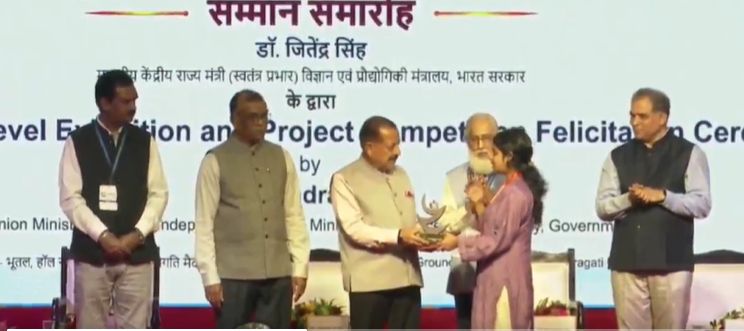
Sixty-two young innovators under the INSPIRE-MANAK scheme were felicitated at the 12th National Level Exhibition and Project Competition (NLEPC), organised by the Department of Science and Technology (DST), Government of India, in collaboration with the National Innovation Foundation–India (NIF), on October 14 in New Delhi.
Congratulating the awardees and presenting the awards, Dr Jitendra Singh, Union Minister of State (Independent Charge) for Science and Technology and Earth Sciences, encouraged the young innovators to keep questioning, experimenting and learning, and to explore opportunities to develop their ideas further.
In his address, he emphasised that nurturing young innovators from the school level would help strengthen India’s innovation ecosystem and contribute to the vision of Viksit Bharat.
INSPIRE-MANAK, which stands for Million Minds Augmenting National Aspirations and Knowledge, is a flagship initiative of the Department of Science and Technology implemented in collaboration with the National Innovation Foundation–India, an autonomous body under DST. The programme encourages students from Classes VI to XII to develop original ideas and innovations rooted in science and societal applications.
Since its inception in 2017 a total of 18,27,580 students have been selected under INSPIRE-MANAK up to 2025–26. The Department has organised 11 National Level Exhibition and Project Competitions, at which 7,444 students exhibited their innovative projects and models.
During 2023–24 and 2024–25, 46,926 and 50,009 students, respectively, were selected under the scheme. The 12th NLEPC brought together students selected during these two financial years, providing a national platform to showcase their projects, interact with experts and receive exposure and mentorship.
Under the programme, selected students are supported in developing their ideas into models and proof-of-concept prototypes, with opportunities to improve their projects through workshops and interaction with experts and leading technical institutions. The initiative aims to nurture scientific temper, creativity and innovation from an early age and encourage students to turn observations of everyday challenges into practical solutions.
The Minister said 25 students had already taken their products to market, while around 250 intellectual property rights had been generated by young innovators. Some students, he said, were earning lakhs of rupees while still in school, demonstrating how scientific curiosity, commitment and access to opportunities can transform ideas into practical outcomes.
The ceremony was attended by Prof. Umesh V. Waghmare, Secretary, Department of Science and Technology; Prof. Anil D. Sahasrabudhe, Chairperson, National Innovation Foundation–India; Dr. Umesh Kumar Sharma, Head, Science and Technology Capacity Building Division, DST; and Dr. Arvind C. Ranade, Director, National Innovation Foundation–India, along with senior officials, teachers, mentors and other stakeholders. The INSPIRE-MANAK 2026 Compendium was also released on the occasion.
https://x.com/DrJitendraSingh/status/2110370962155901026
Interacting with the young innovators, Dr. Jitendra Singh said the students were the main attraction of the programme and that their work had demonstrated the true value of INSPIRE-MANAK. Recalling his initial scepticism about the programme’s name when it was introduced, he said the achievements of the participating students had convinced him of its significance and the high standards of innovation it was fostering.
The Minister referred to several projects presented at the exhibition that addressed everyday challenges through scientific and technological solutions. These included an AI-based alcohol detection system designed to prevent a vehicle from starting when alcohol is detected, an ultrasonic washing machine that can save water, a device designed to deter stray dogs through vibrations, and assistive technology for visually impaired students. He also referred to a tracking walking stick showcased at the exhibition.
Referring to India’s expanding start-up ecosystem, the Minister said the country’s start-up numbers had grown from around 350–400 in 2014 to approximately 2.5 lakh, with nearly 60 per cent located in Tier-II and Tier-III cities. He said young people today had greater access to information and opportunities, and could achieve significant outcomes through passion, commitment and hard work.
Dr. Jitendra Singh called for stronger industry partnerships to help promising student innovators improve their products, respond to market requirements and explore commercial opportunities. He suggested facilitating business-to-business interactions for young innovators so that their ideas could receive industry feedback and potentially progress towards wider application.
The Minister said promising innovations should not remain confined to exhibitions or working models. Students with entrepreneurial potential should receive opportunities to engage with industry and develop solutions that meet practical needs. He encouraged stakeholders to explore ways of connecting young innovators with relevant enterprises and technical expertise at an early stage.
Citing the example of a policy change that removed the three-year existence requirement for deep-tech start-ups supported by the Council of Scientific and Industrial Research (CSIR), Dr. Jitendra Singh said innovation required a willingness to support new ideas and take calculated risks. He called for greater collaboration between the Government and industry to nurture student innovators and help them develop their technologies.
The Minister also stressed the importance of mentorship in enabling students to recognise their strengths, refine their ideas and navigate the journey from an initial concept to a practical application. He proposed that a future edition of the programme include a dedicated session in which young innovators could speak directly about their work and experiences.
Dr. Jitendra Singh proposed that future editions of the programme include a dedicated session in which each participating student is accompanied by at least one parent or guardian. He said parents may sometimes be unfamiliar with the nature of a child’s innovative work and, without intending to discourage them, may inadvertently interrupt the time and effort required to pursue an idea.
The Minister emphasised that parents, teachers and mentors all have an important role in creating an environment where children feel encouraged to experiment, question established approaches and learn from failure. He also stressed the need for students to understand their own capabilities, seek appropriate guidance and remain open to learning as technology and opportunities continue to evolve.
Dr. Jitendra Singh said young innovators must continue developing their skills and adapting to new knowledge rather than becoming complacent after an achievement. He encouraged them to explore their interests, make informed choices and keep improving their ideas through experimentation and practical experience.
Speaking at the event, Prof. Umesh V. Waghmare, Secretary, Department of Science and Technology, said the exhibition reflected the ability of young students to identify problems faced by society and consider how science could help address them. He referred to the geographical diversity of participants, from the Andaman and Nicobar Islands to Kashmir and from Mizoram to Mumbai, as well as the variety of projects covering agriculture, healthcare, environmental protection, accessibility, energy, water conservation, safety and improving everyday life for older people.