

This year marks the 60th anniversary of International Literacy Day, observed under the theme “Literacy for people, the planet and prosperity.” The theme calls for a closer examination of the progress made in literacy, the challenges that persist and the ways education systems must respond to a rapidly changing world.
Globally, the challenge remains significant. India, however, has recorded encouraging progress, with its literacy rate reportedly rising to 81% in 2024, from 77% in 2023. Marking the occasion, Union Education Minister Pralhad Joshi called for a renewed commitment to ensuring that no one is left behind in the journey of learning, stressing that an educated and empowered citizenry is the strongest foundation for a Viksit Bharat.
India’s progress in literacy has been the result of a collective effort involving governments, communities, civil society and the corporate sector. Beyond government programmes, several organisations are working to address literacy and learning challenges at scale.
The Central Square Foundation, for instance, works with governments across 11 states to strengthen foundational literacy and numeracy through teacher training, learning resources and assessments. Its work has contributed to foundational learning programmes across thousands of schools.
At the community level, the Food4Thought Foundation has adopted a different approach by expanding access to books and reading spaces. The organisation has established 622 school and community libraries, reaching more than 70,500 readers, demonstrating the important role access to reading material can play in the literacy journey.
As literacy rates improve, however, the focus is increasingly shifting from simply getting children into school to ensuring that education results in meaningful learning, continued education and greater opportunities.
Sustained Access and Opportunity
For Devyani Jaipuria, Pro Vice Chairperson of DPS and Director on the Board of RJ Corp, education has been a central focus of her philanthropic work for more than two decades. Through Shiksha Kendra, an initiative supporting children from underserved communities, the emphasis has been on providing sustained access to education and helping students continue their learning journeys.
The initiative has reached more than 25,000 students over the years. Its impact is reflected in the journeys of students who have gone on to pursue higher education and secure opportunities with organisations including Deloitte, Amazon, SpiceJet, ICICI Bank, Tata Solar and Decathlon. One student is currently pursuing nursing studies in Georgia after receiving educational support through the initiative.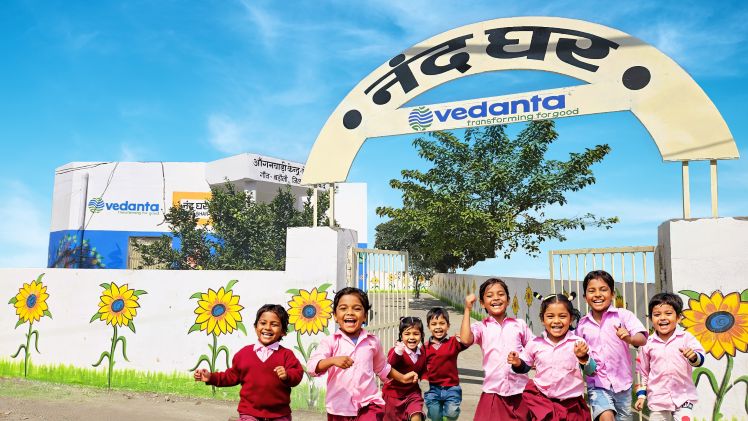
From Foundations to Futures
On International Literacy Day, Vedanta Group highlighted its education initiatives reaching over 6 lakh children and youth across India, with more than 50% female participation, through a network of over 15,000 Nand Ghars and 500 schools and community learning centres.
Vedanta’s approach follows a three-pronged pathway: Building Strong Foundations through early childhood education, nutrition and health; Enabling Learning and Aspiration through academic support, technology and mentorship; and Creating Opportunities by linking education with higher studies, competitive examinations, vocational skills and employment.
Its flagship Nand Ghar initiative modernises Anganwadis into centres integrating early childhood education, nutrition, healthcare and women’s empowerment. Spread across 18 states, the programme reaches nearly 5 lakh children and 4 lakh women. Nand Ghars also provide women and adolescent girls access to learning content, life skills and awareness programmes while strengthening the capacity of Anganwadi workers.
At Hindustan Zinc, Shiksha Sambal reached over 13,000 government-school students in FY26, providing academic and remedial support and recording a 96% pass percentage. Its Unchi Udaan programme supports students preparing for competitive examinations and higher education. Five students scored above the 95 percentile in JEE Main, including a highest score of 99.23 percentile.
Vedanta is also expanding access to future-ready learning through STEM laboratories equipped with AI-enabled panels and AR/VR tools. In Odisha, Vedanta-supported Ekal Schools benefit over 10,000 children, while initiatives such as Project Vidyagraha and the Gyan Jyoti Digital Education Project are widening access to educational content and technology. In Kalahandi, DAV Vedanta International School, the district’s first English-medium school, serves students, around 85% of whom are from tribal communities.
The Group’s initiatives increasingly focus on helping young people translate education into skills, employment and livelihoods. At BALCO, students receive support for competitive examinations, while the Vedanta Skill School provides market-linked vocational training and employment pathways. At ESL Steel, all Class 10 students supported through its education programme cleared their board examinations, with 84% securing first division.
Literacy in a Digital World
Marking International Literacy Day, Tata Consultancy Services (TCS) reiterated its commitment to empowering individuals and communities through literacy, digital inclusion and technology-driven learning.
At the forefront of these efforts is the TCS Literacy Programme, launched by Dr F.C. Kohli. For more than 26 years, the programme has addressed literacy needs, particularly among women and underserved communities, while enabling greater participation in India’s increasingly digital economy.
Since its inception, the programme has empowered more than 5.1 million beneficiaries and 493,928 facilitators. In FY26 alone, it reached 2.7 million learners.
The programme seeks to go beyond basic literacy by promoting functional, financial and digital literacy, while also creating awareness about citizen entitlements, digital fraud and disaster resilience. It is delivered through personalised regional content and technology-enabled learning pathways.
The programme also includes Each One Empowers One, an initiative that enables employees of TCS and other Tata group companies, along with citizens across India, to volunteer and support non-literate members of their communities. Since its launch in 2022, the digital platform has registered more than 11,177 volunteers and certified 20,044 beneficiaries.
Joseph Sunil Nallapalli, Global Head, CSR, TCS, said: “At TCS, we view literacy as a catalyst for social and economic empowerment, enabling individuals to participate more fully in society and shape better futures for themselves and their families. Through the TCS Literacy Programme, we are helping create pathways to dignity, self-reliance and sustainable livelihoods for millions.”
Extending its commitment to school education, TCS also runs Ignite My Future (IMF) and go Innovate Together (goIT), global programmes designed to equip students with future-ready skills through computational thinking, innovation and career readiness. Since inception, IMF has impacted more than 2.7 million educators and students across 17 countries, while goIT has reached 396,342 students across 67 countries.
As India continues to make gains in literacy, the larger challenge is to ensure that these gains translate into better learning, sustained educational participation and greater economic and social opportunity. On International Literacy Day, the conversation is therefore moving beyond literacy as a statistical milestone towards education as a pathway to empowerment, self-reliance and a more prosperous future.