

Even before turning a week old, the ‘School Thik Karo’ (Fix Government Schools) campaign launched by the Cockroach Janta Party (CJP) on August 15 is heading for a major showdown in Rajasthan.
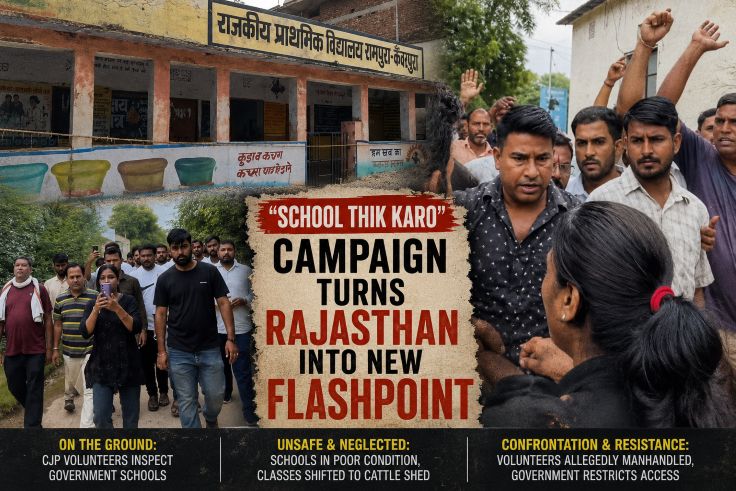
CJP has demanded the resignation of Rajasthan Education Minister Madan Dilawar within 48 hours after CJP volunteers visiting a government primary school at Rampura-Kanwarpura near Jaipur were reportedly prevented from entering and allegedly manhandled and beaten by a crowd. The school had reportedly been declared unsafe earlier, following which classes were shifted to a cattle/buffalo enclosure. CJP blamed BJP workers for the incident, while the ruling party has denied the allegation.
Rajasthan has emerged as the campaign’s most politically contentious front after CJP said it had already received requests concerning schools in nine districts—Jaipur, Ajmer, Jodhpur, Udaipur, Dholpur, Bharatpur, Kota, Barmer and Hanumangarh. On August 19, CJP co-convenor Ashutosh Ranka challenged Education Minister Madan Dilawar to identify 10 of the best school campuses developed during his tenure, saying the party would inspect them.
CJP had said its volunteers would inspect schools, document deficiencies and press the administration to undertake repairs. At the same time, on August 16–17, the Rajasthan Education Department issued directions restricting outsiders from entering government-school premises without permission from the principal or head of the institution. The restrictions also covered photography, videography, interviews, audio recording and live-streaming involving students, teachers or school activities. Visitors were required to make entries in a visitor register, while government officials performing official duties were exempted.
The government’s move, however, may have handed CJP another rallying point for mobilising public opinion on the issue. Given the mood among the younger generation and the support witnessed at the Jantar Mantar protest, Jaipur could potentially become another flashpoint for the Rajasthan Education Minister.
Rajasthan is the third State, after Maharashtra and West Bengal, where CJP’s ‘School Thik Karo’ campaign has made headlines, drawing considerable publicity through its field exercises and the confrontations that followed.
The first major field exercise took place at Santuk Pimpri village in Hingoli district, Maharashtra, where CJP founder Abhijeet Dipke personally audited a government school on Independence Day. The audit reportedly found broken windows, dirty and poorly maintained toilets and other deficiencies affecting the learning environment and students’ health, besides wider infrastructure problems requiring administrative attention.
In West Bengal, CJP supporter Abdul Hafiz reportedly visited his former government school in Bankura district as part of the ‘School Thik Karo’ campaign and recorded its poor infrastructure. He and his elderly father were subsequently allegedly assaulted at their home. His father later died after sustaining serious injuries.
CJP has thus quickly shifted its attention from its earlier agitation over examination leaks and education-system accountability to government-school infrastructure, public scrutiny and local accountability through the ‘School Thik Karo’ campaign launched on August 15.
The nationwide campaign is designed to inspect and document the condition of rural government schools and press local administrations to undertake repairs. Its basic idea is to turn parents, villagers and elected local representatives into a kind of social-audit network for government schools. CJP founder Abhijeet Dipke has added an accountability challenge to politicians and education officials, arguing that government schools have remained neglected irrespective of which political party is in power.
CJP is seeking the support of parents and volunteers for the initiative. It has asked parents to inspect basic facilities and conduct social audits, and sarpanches to take responsibility for improving government schools in their villages. Volunteers have been asked to document deficiencies in classrooms, toilets, drinking water, roofs, furniture and other infrastructure. Under the campaign’s charter, local authorities are expected to respond to identified deficiencies rather than merely promise improvements. Members of the public can contribute by using photographs and videos to highlight poor conditions and, where improvements are made, document the changes.
CJP has further raised the temperature by challenging politicians and bureaucrats to enrol their children in government schools if they believe the public-school system is good enough. On August 18, Dipke challenged ministers, education officials, principals and teachers who send their own children to private schools to instead enrol them in government schools. His argument is that if those responsible for the public education system themselves use government schools, there would be much greater pressure to improve them.
This is potentially one of CJP’s more politically potent messages because it shifts the debate from merely asking whether “schools need more money” to a more uncomfortable question: “Do those running the system actually trust the system?”