

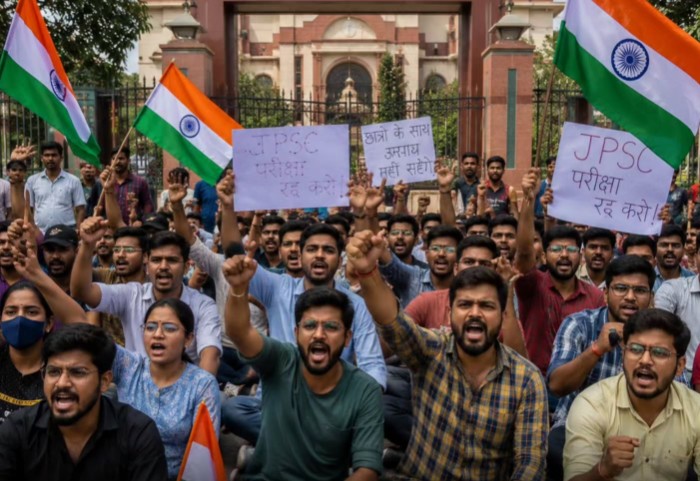
Even after the Jharkhand government cancelled the 14th JPSC examination and two other JPSC examinations and promised reforms to the examination system, student groups staging a sit-in protest over the 14th JPSC Combined Civil Services Preliminary Examination, held in April this year, continue to mobilise. According to reports, the groups have announced plans to gherao Chief Minister Hemant Soren’s residence on August 20.
The agitation that began soon after the results of this exam were declared on July 2, has widened over three interconnected concerns — examination integrity, employment and trust in institutions. For thousands of young aspirants preparing for government jobs, the issue has become one of whether the state’s recruitment agencies can conduct examinations fairly and transparently and provide a predictable recruitment process. Therefore, this is seen as an opportunity to compel the government to address these issues.
The immediate trigger for the protest was the 14th JPSC Combined Civil Services Preliminary Examination, conducted on April 19, 2026. The examination was held for 103 posts, with more than 36,000 candidates reportedly appearing. The preliminary results were declared on July 2, following which candidates began questioning the results and seeking greater transparency over marks, cut-offs and the evaluation process.
The role of TSR Data Processing Private Limited (TDPL), a Lucknow-based private testing and examination agency associated with conducting examinations for both the Jharkhand Staff Selection Commission (JSSC) and JPSC, has also emerged as a major point of contention. Protesters have questioned the decision to entrust examination work to the company despite allegations concerning its previous record.
The controversy eventually prompted a state investigation, with the Jharkhand CID examining the role of individuals and agencies connected with the examination process, including JPSC officials and TDPL. Former JPSC chairman L. Khiangte was arrested on August 10.
The arrest, however, has not satisfied the protesters, who are demanding a Central Bureau of Investigation (CBI) probe, arguing that an independent investigation is necessary to establish responsibility and restore confidence in the recruitment process.
A section of aspirants has alleged irregularities in the examination process and questioned unusual patterns in the results. They have also raised questions about the disclosure of marks and cut-offs and the manner in which the examination was evaluated. It was these concerns that triggered an agitation that rapidly moved from petitions and demonstrations to sustained street mobilisation. JLKM leader Devendra Nath Mahto, known for his activism, became the most visible face of the movement. On August 2, Mahto began a hunger strike, giving the agitation a national outreach. That triggered solidarity and visits from student leaders, activists and politicians to Ranchi.
The escalation came on August 10, when thousands of protesters marched towards the Jharkhand Assembly. The march turned tense after protesters breached several police barricades. Police used lathis, tear gas and water cannons to disperse the demonstrators. The confrontation significantly widened the political dimensions of the agitation, turning what began as an examination dispute into a major confrontation between protesting youth and the state government.
Political parties have also entered the controversy. The BJP and its youth wing, BJYM, have staged demonstrations and demanded cancellation of the examination and a CBI investigation. The AJSU’s youth and student wings have also joined the protests.
What began with the demand to “cancel the 14th JPSC examination” has increasingly evolved into a call to “reform JPSC/JSSC and clean up the entire recruitment system.” For thousands of young people in Jharkhand, government examinations are not simply competitive tests. They represent years of investment in education and preparation and, for many, a hoped-for route to stable employment. A recruitment examination that is cancelled, delayed or challenged can therefore have consequences far beyond a single examination cycle.
Aspirants can spend years preparing for competitive examinations while recruitment calendars remain uncertain. Repeated cancellations and delays can push candidates towards age limits, while allegations of malpractice can create a perception that merit alone may not determine selection.
The Jharkhand agitation therefore presents an opportunity to address a much larger issue than the fate of one examination. Rebuilding confidence in the recruitment process will require transparency, accountability, timely examinations and credible mechanisms for addressing complaints.
For the government, recruitment commissions and political stakeholders, the immediate challenge is not merely to resolve the current protest but to restore trust among a generation of young aspirants who expect the state’s recruitment system to be fair, transparent and predictable.