

A team of engineering faculty members and student researchers at SSN College of Engineering has developed a safety mechanism that could significantly improve survival chances during flooding emergencies. Vehicle especially cars submersion incidents, whether caused by floods, accidents near water bodies, or extreme weather conditions, can turn fatal, as passengers are often unable to open doors or find viable exit routes within a limited time window. In many drowning scenarios, passengers are left with only a narrow window to escape, as rising water levels and pressure differences make door operation nearly impossible.
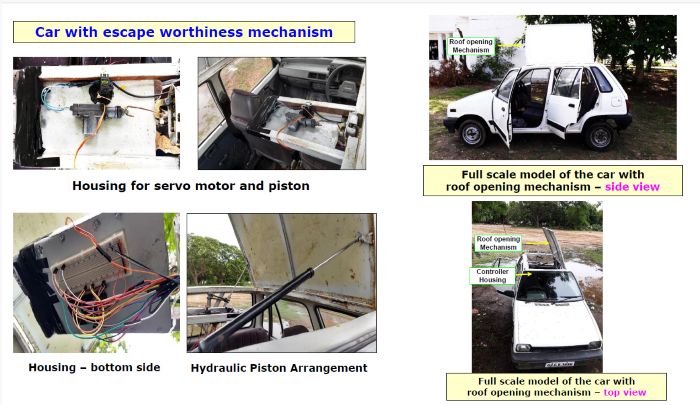
The innovation developed at SSN aims to significantly improve survival chances by creating a larger and more accessible escape path. The innovation, titled ‘Improved Escape Worthiness of Car Occupants Under Drowning Environment’, introduces a roof-opening escape system designed to activate when a vehicle begins to submerge in water, addressing a critical safety gap where conventional car doors often fail to open due to external water pressure.
The innovation has been developed by Dr S. Suresh Kumar, Associate Professor, Department of Mechanical Engineering, along with student researchers B. Vishal and Neil Ashwin Raj, highlighting SSN’s focus on student-led, application-driven engineering research.
The SSN-developed system uses a combination of sensors and a pneumatically controlled mechanism to detect submersion conditions and trigger the opening of the vehicle’s roof at an early stage. By enabling a wider and more accessible exit point, the system is designed to support faster evacuation for all occupants, including those seated in the rear.
Unlike conventional approaches that rely on smaller openings or electrically dependent systems, the design focuses on early activation and a non-explosive hybrid control mechanism, ensuring safer and more reliable operation under high-risk conditions.
The technology has undergone extensive validation, including Computational Fluid Dynamics (CFD) simulations and full-scale real-time testing on a modified vehicle. The prototype was tested across multiple conditions such as flat sinking, side tilt, and nose-diving scenarios, where it demonstrated consistent performance