

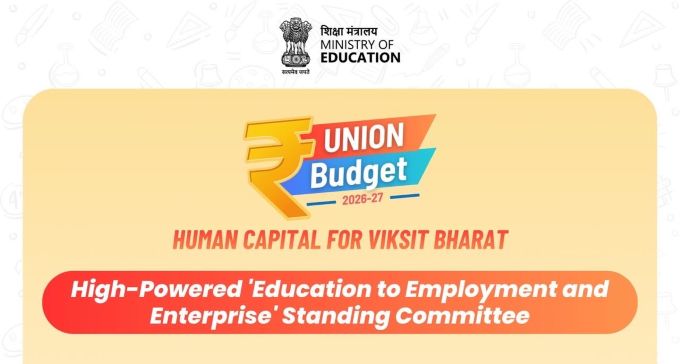
A High-Powered ‘Education to Employment and Enterprise’ Standing Committee provided under the Union Budget 2026-27 and envisaged to help India achieve a 10% share of the global services market by 2047, has been set up under the chairpersonship of CEO, NITI Aayog, with and Experts/Academia. It includes representation from Ministry of Labour and Employment, Department of Commerce, Department of Economic Affairs, Ministry of Electronics & IT, Department of Higher Education, Ministry of Skill Development & Entrepreneurship, Department of School Education & Literacy, Ministry of Statistics & Programme Implementation, Governments of Andhra Pradesh, Bihar, Maharashtra, and Uttar Pradesh, NASSCOM, FICCI, CII, FISME, SEPC, and other experts. The Committee held its first meeting on May 22 in New Delhi.
The committee is expected to prioritise areas to optimise growth, employment, and exports, assess the impact of frontier technologies including AI, on jobs and skill requirements, and recommend appropriate measures.
On 22nd May 2026, NITI Aayog convened the first meeting of the said Standing Committee under the chairpersonship of Smt. Nidhi Chibber (CEO, NITI Aayog). The attendees included Smt. Debashree Mukherjee (Secretary, Ministry of Skill Development & Entrepreneurship), Ms. Debjani Ghosh (Distinguished Fellow, NITI Aayog), and other senior officers from the Ministries/Departments, State Governments, Industry Associations, and Experts/Academia.
Dr. Sonia Pant, Programme Director, Services Division, NITI Aayog, made a detailed presentation on the potential of the Services sector both in terms of economic value creation and employment generation. Smt. Nidhi Chibber, CEO, NITI Aayog, underlined the importance of continued efforts towards aligning education, skilling, and employment ecosystems with the evolving requirements of the economy. She observed that India’s demographic dividend presents opportunities to accelerate growth through appropriate policy measures to create productive employment and entrepreneurial opportunities for the youth.
The discussions covered a range of issues including labour force participation, youth employment, education and skill alignment, formal and informal economy, and workforce preparedness for jobs. Participants also deliberated on aspects such as the transition of labour towards non-farm sectors, adoption of frontier technologies, and the need for strengthening industry-relevant skilling pathways.
The Committee noted that the Services sector continues to play a pivotal role in India’s economic development, and highlighting its growing contribution to economic resilience, export competitiveness, employment quality, global value chains, and potential to contribute to the vision of a Viksit Bharat.