

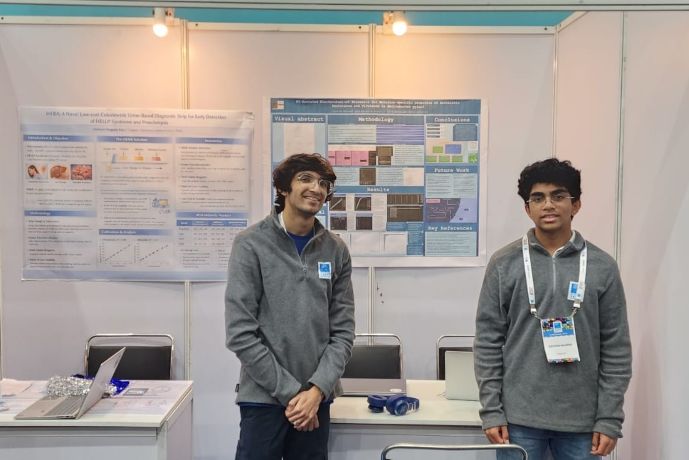
Demonstrating exceptional research aptitude, scientific rigour, and interdisciplinary innovation, four students from Greenwood High International School, Bengaluru secured the Gold Medal at the IRIS National Fair 2025–26, one of India’s most prestigious pre-college STEM research platforms. Representing the GWH International Campus, Sarjapur, the winning students, Gautam Mahesh and Rachvik Arora (Team 1), along with Youbin Duan and Aarush Mandala (Team 2), all IBDP Year 1 students, were recognised for two independent research projects that address complex challenges in medical diagnostics and advanced imaging.
The IRIS National Fair brought together 75 young innovators from 12 states and 24 cities, providing a competitive platform for students to present original research across multiple scientific disciplines. The programme, organised by EXSTEMPLAR Education Linkers Foundation, serves as the national qualifying stage for participation in the International Science and Engineering Fair (ISEF) 2026, widely regarded as the world’s leading global science research competition for school students.
Gautam Mahesh and Rachvik Arora developed an AI-assisted biosensor designed to detect virulence and antibiotic resistance mutations in Helicobacter pylori, a bacterium linked to several gastrointestinal diseases. Their project integrates artificial intelligence with biosensor-based diagnostics to enable earlier and more precise detection of pathogenic mutations, potentially improving treatment outcomes and supporting global efforts to address antimicrobial resistance. The project was recognised for its strong translational potential and scientific depth, earning the team a Gold Medal and advancement to the final selection round for international representation.
Youbin Duan and Aarush Mandala presented a project titled “Frequency Encoded Proton Electron Microscopy on the Retina,” which explored ways to enhance conventional Two-Photon Excitation Fluorescence (TPEF) imaging. Through a physics-driven simulation approach, the students demonstrated how frequency encoding techniques could significantly improve retinal imaging quality while reducing exposure time. The research offers promising implications for future developments in ophthalmic imaging and vision science.
The jury commended both teams for their analytical depth, originality, and ability to apply complex scientific principles to real-world challenges. Their work stood out for combining theoretical understanding with practical experimentation and simulation.
“We are immensely proud of our students for their dedication to scientific inquiry and their ability to pursue research that addresses meaningful global challenges. Their success reflects Greenwood High’s commitment to fostering curiosity, critical thinking, and innovation through inquiry-driven learning,” said Mrs. Niru Agarwal, Managing Trustee of Greenwood High International School.