

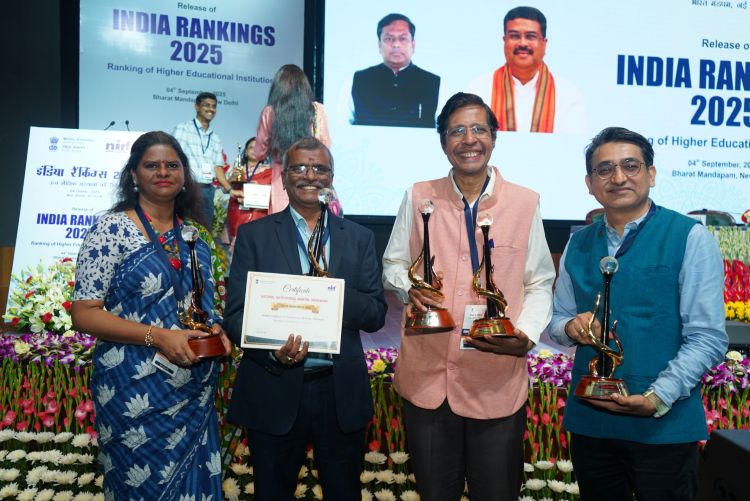
The annual NIRF Rankings 2025 arrived this September—four months late, shrouded in rumors that the exercise might be scrapped altogether. For weeks, skeptics, global lobbyists, and their local collaborators whispered that India’s decade-long experiment with homegrown rankings had collapsed. And yet, the NIRF survived. Not just survived, but expanded—marking ten uninterrupted years of a project often derided as bureaucratic, opaque, and overly centralized.
That survival itself is a statement. The persistence of NIRF, therefore, is not just administrative survival—it is symbolic of a country negotiating its higher education identity amid a globalized and often skeptical landscape. It is not merely a statistical exercise, but a cultural and strategic intervention—exposing higher education institutions (HEIs) to the importance of visibility, accountability, and perception. The fact that 7,692 institutions participated this year—an all-time record— underscores how seriously HEIs now value the exercise. Even critics, by engaging with the process, indirectly acknowledge its growing legitimacy.
Let’s be honest: rankings are flawed everywhere. Whether it’s the QS or Times Higher Education lists, credibility and conflicts of interest stalk all global rankings. India could have continued to play by their rules. Instead, it chose to build its own framework. Imperfect, yes. But also distinctly Indian—reflecting domestic priorities rather than borrowed yardsticks.
The easiest critique of NIRF is that it is bureaucratic busywork. But dismissing it misses the point. Rankings, however flawed, are about visibility, accountability, and aspiration. They push institutions to measure themselves, to compete, and to signal seriousness to students, parents, and policymakers.
At ten years, NIRF is not perfect. But in a world where global rankings often serve Western interests, building a domestic, transparent, and participatory culture of rankings is a strategic necessity. To strengthen research integrity, NIRF introduced negative marking for retracted papers and reinforced restrictions on self-citations. In a context where academic misconduct often erodes credibility, such measures send a powerful signal.
True to its evolving nature, NIRF 2025 introduced several significant changes. For the first time, a category aligned with the Sustainable Development Goals (SDGs) was launched, rewarding institutions for promoting green practices, inclusivity, and education aligned with global sustainability targets. This places India in dialogue with international frameworks, while retaining a local lens.
The real takeaway from NIRF 2025 isn’t just that IIT Madras won again. It’s that India has kept its nerve, kept its rankings, and kept the conversation alive. In higher education, as in democracy, the process matters as much as the winners.
While the top positions remain largely predictable—IIT Madras (Overall and Engineering), IISc Bengaluru (University), IIM Ahmedabad (Management), and AIIMS Delhi (Medical)—the rankings also create space for new stories from India’s educational margins. Raipur, long stigmatized for its struggling universities, emerged as a quiet success: IIM Raipur ranked 15th in management, AIIMS Raipur reached 31st in medical, NIT Raipur secured 35th in Architecture & Planning and IGKV Raipur achieved 28th overall. Collectively, these signal a regional turnaround.
Likwise, Shivaji University climbed from the 51–100 band to 45th, defying the pessimism surrounding state universities. Conversely, NITK Surathkal’s slip from 46 to 54 overall shows how consistency requires ongoing effort and renewal. In the colleges category, the dominance of Delhi University colleges continued. Hindu College emerged as the new leader.
At the same time, India’s Central HEIs reconfirm their dominance, almost to the point of predictability. IIT Madras retained its overall #1 spot for the seventh consecutive year; IISc Bengaluru remained #1 university for the tenth year; IIM Ahmedabad consolidated its sixth consecutive win in management; and AIIMS Delhi once again dominated medicine. These results highlight the strength of India’s flagship institutions, but also raise a question: does such continuity reflect true excellence, or also a system that makes it harder for challengers to break through?
At ten years old, NIRF is neither flawless nor fully immune to criticism. It remains bureaucratic in structure and contested in perception. Yet, its survival and expansion are achievements in themselves. The framework has succeeded in sparking conversations about transparency, performance, and accountability in Indian higher education. It rewards consistency but also celebrates underdog narratives, giving legitimacy to regional institutions striving for recognition. Its innovations—SDG-linked rankings and research integrity checks—show an intent to mature beyond tokenism.
In an era when global rankings are questioned for their politics, Western biases, and hidden interests, India’s insistence on building a domestic, participatory, and increasingly trusted ranking culture is significant. The story of NIRF at ten, then, is not only about who topped the charts, but about a country’s continuing struggle to define, measure, and celebrate its own higher education ecosystem on its own terms.