

From semiconductors and electronics to automotive, education, healthcare, design, AI and digital services, industry leaders and academic experts alike view the Budget as a decisive shift from intent to execution—where education, skilling and employability are being structurally aligned with India’s long-term development goals.
For the electronics sector, the Budget marks a historic inflection point. Saleem Ahmed, Officiating Head of the Electronics Sector Skills Council of India (ESSCI), described it as a defining moment for skills-led growth.
“The Union Budget 2026–27 strongly reinforces India’s ambition to emerge as a global powerhouse in electronics and semiconductors, and from the perspective of the Electronics Sector Skills Council of India (ESSCI), this is a defining moment for skills-led growth,” Ahmed said.
At the heart of this transformation is the launch of the India Semiconductor Mission (ISM) 2.0. With its focus on indigenous equipment, materials, full-stack IP and industry-driven research and training centres, ISM 2.0 is expected to reshape the entire semiconductor value chain.
“The launch of India Semiconductor Mission 2.0… will significantly reshape the nature and scale of skill requirements across the semiconductor value chain. ESSCI views this as a critical opportunity to build a future-ready workforce in chip design, fabrication support, advanced packaging, testing, electronics manufacturing services and allied domains,” Ahmed added.
In the apparel and textile sector, Padmashri Dr. A. Sakthivel, Chairman, Apparel, Made-Ups and Home Furnishing Sector Skill Council (AMHSSC), highlighted the Budget’s role in strengthening livelihoods.
“The package reflects a strong intent to modernise the sector, strengthen livelihoods, and enhance India’s competitiveness in domestic and global markets. Samarth 2.0 and allied skilling initiatives will equip workers with contemporary manufacturing and design skills, supporting productivity gains and adoption of Industry 4.0 technologies,” he said.
The automotive sector echoed similar sentiments. Vinkesh Gulati, Chairperson, Automotive Skills Development Council (ASDC), said the Budget sends a strong signal for manufacturing-led growth.
“Union Budget 2026–27 sends a clear and positive message about India’s commitment to manufacturing-led growth, with skill development firmly placed at the centre of the national agenda,” Gulati said.
He added that targeted investments in advanced manufacturing, clean mobility and capital goods open new opportunities across vehicle manufacturing, EVs, batteries, electronics and logistics.
“From a skills standpoint, the emphasis on an Education to Employment approach and industry-aligned skilling is both timely and necessary. The automotive sector is rapidly evolving and needs a future-ready workforce skilled in mechatronics, electronics, embedded systems, AI-enabled manufacturing, quality and safety systems, green technologies and digital tools,” Gulati said.
MSMEs emerge as one of the biggest beneficiaries. Sunil Kumar Roy, Dean, Manav Rachna University, said: “Recognising MSMEs as engines of growth… the creation of a ₹10,000-crore fund to develop ‘champion SMEs’ is reflective of the Government’s commitment to scale up manufacturing and competitiveness.”
Across sectors, a common thread emerges: India is moving from degree-driven education to job-linked capability creation. Whether through semiconductor fabs, automotive plants, MSME clusters, healthcare systems or AI platforms, the success of India’s growth story now hinges on its ability to skill, reskill and continuously upskill its workforce.
India’s Skills minister, Jayant Chaudhary commenting on the union budget said that prioritising productivity, competitiveness and cutting-edge technologies, including AI, it lays a strong foundation for Viksit Bharat through sustained structural reforms and people-centric growth. A strong push to manufacturing, MSMEs and services stands out as a key growth engine. Investments across biopharma, semiconductors, electronics, textiles (SAMARTH 2.0), chemicals, capital goods and sports manufacturing will deepen domestic value chains and position India as a trusted global production hub. The three-pronged MSME framework, ₹10,000 crore SME Growth Fund, TReDS-based liquidity, and professional support through “Corporate Mitras”, will empower entrepreneurs to scale and compete.
“Initiatives such as AI-backed Bharat Vistaar to integrate agri-stack, creation of SheMarts, Biopharma SHAKTI, ISM 2.0, rejuvenation of industrial clusters, creation of champion MSMEs through equity support, and the 10-year Khelo India Mission reflect a future-ready approach that integrates technology, health, agriculture and human capital,” he added.
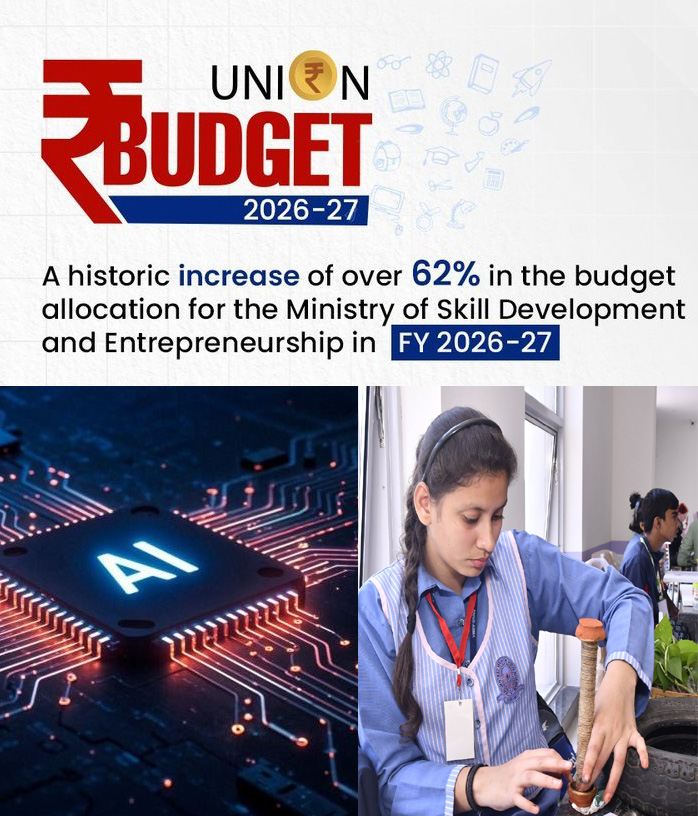
The minister said, a defining feature of this Budget is its decisive commitment to skill development and human capital. The Ministry of Skill Development and Entrepreneurship has received a 62% increase in allocation, with the budget rising from ₹6,100 crore to ₹9,885.80 crore, affirming the Government’s resolve to place skills at the centre of economic transformation. From NSQF-aligned programmes and caregiver training to modernised textile skilling, sports ecosystems and industry-linked pathways, this Budget creates a seamless bridge from education to employment and entrepreneurship, preparing youth to lead in manufacturing, services, technology and the care economy.
The renewed emphasis on the services sector, including healthcare, medical value tourism, AVGC, design, IT and hospitality, recognises that India’s growth will be powered as much by skills and services as by infrastructure. Continued public capital expenditure will crowd in private investment and expand opportunities across Tier-II and Tier-III cities.
“Taken together, Budget 2026–27 is not just a financial statement, it is a national mission document. It strengthens economic foundations, unlocks enterprise, empowers farmers and MSMEs, and invests deeply in skills,” he added.
Skills, Education and Employability: The Core of Viksit Bharat
Beyond manufacturing and technology, the Union Budget 2026–27 positions human capital as the central pillar of India’s long-term growth strategy, with a clear shift towards education-to-employment outcomes, inclusivity and future-ready skills.
Dr. Anjali Sane, Professor & Dean, School of Economics and Commerce, MIT World Peace University, Pune, said the Budget firmly anchors India’s Viksit Bharat vision in people-centric development. “The Union Budget 2026–27 places human capital development at the centre of India’s Viksit Bharat vision, with a clear focus on education quality, skilling, and employment readiness. A key highlight is the establishment of a Centre of Excellence for Artificial Intelligence in Education, aimed at advancing digital pedagogy and personalized learning,” she said.
She added that digital learning in Indian languages, girls’ hostels in every district, five National Centres of Excellence in Skilling and enhanced MSME support together create a framework for a skilled, inclusive and globally competitive workforce.
Echoing the MSME focus, Sunil Kumar Roy, Professor and Dean, School of Business, Manav Rachna University, said the Budget strengthens India’s manufacturing backbone.
“The Budget 2026 appears to be progressive and in line with the vision of Viksit Bharat 2047. Recognising MSMEs as engines of growth, the top-up of the Self Reliance India Fund with ₹4,000 crore and the creation of a ₹10,000-crore fund to develop ‘champion SMEs’ reflect the Government’s commitment to scale up manufacturing and competitiveness,” he said.
From an education and services lens, Ranjita Raman, CEO, Jaro Education, highlighted the strong employability focus.
“By placing skill development and industry-linked education at the core of its agenda, the government has acknowledged the need to bridge the gap between learning and employability. University townships near industrial corridors and the Education to Employment and Enterprise Standing Committee reflect a practical, outcome-focused approach,” she said.
She also welcomed the reduction in TCS from 5% to 2% on education and medical expenses, calling it a boost for learner participation and career progression.
For the youth workforce, Prateek Shukla, Co-Founder & CEO, Masai, said the Budget aligns closely with the realities of today’s job market. “The government’s strong focus on growth driven by technology stands out. The emphasis on artificial intelligence, emerging technologies, and industry-led research aligns with roles evolving faster than traditional education systems can keep pace,” he said. He added that ISM 2.0 and structured skilling ecosystems will be critical in creating future-ready jobs and sustaining India’s global competitiveness in digital services.
Jyoti Sharma, CEO, Nasscom Foundation, described the Budget as strongly aligned with inclusive growth. “We welcome the proposed ‘Education to Employment and Enterprise’ Standing Committee, which recognises the need for a cohesive, outcomes-driven approach, especially for the services sector and the evolving impact of AI on jobs,” she said. She also pointed to the creation of SHE Marts and Divyang Kaushal Yojana as key steps towards women-led enterprises and inclusive skilling.
Healthcare skilling emerged as another major pillar. Pravesh Dudani, Founder and Chancellor, said the Budget shifts the sector from peripheral to strategic. “The emphasis on NSQF-aligned education and allied health disciplines signals a move toward job-linked capability creation. Training 1.5 lakh caregivers, introducing ten new allied health disciplines, and setting up new Ayurveda and pharmaceutical institutes reflect a long-term commitment to healthcare workforce capacity,” he said.
On the future of education models, Kuldip Sarma, Co-Founder and Pro-Chancellor, stressed the importance of modular and continuous learning. “The emphasis on apprenticeships and short modular courses addresses the gap between degrees and workplace readiness. Skill universities integrating higher education with industry can convert education expenditure into employability and resilience,” he said.
From a governance and AI perspective, Sridhar Gadhi, Founder & Managing Director, ParadigmIT, said the Budget signals a structural shift. “The 2026 Budget marks India’s shift from e-Governance to intelligent Governance. By calling AI a force multiplier for better governance, it elevates AI to a strategic national priority and pushes sovereign, domain-trained AI across public services,” he said.
On entrepreneurship, Dr. Vishwanathan Iyer, Great Lakes Institute of Management, noted a mature policy approach. “The focus has shifted from incentives to scale, exports and financing infrastructure. The SME Growth Fund and removal of courier export caps strengthen capital efficiency and survival rates for startups,” he said.
Design and creative skills also received a strong push. Revathi Kant, Chief Design Officer, Titan Company, said the Budget recognises design as an economic multiplier.“The proposal to establish a new National Institute of Design, especially for the eastern and north-eastern region, is a timely step to address structural talent gaps. The integrated push for handloom, handicrafts and AVGC builds a strong creative supply chain,” she said.
From the EdTech sector, Kashyap Dalal, Co-Founder and Chief Operating Officer, Simplilearn, highlighted the rise of flexible learning.
“The focus on micro-credentials and apprenticeships creates a pathway for professionals to upskill continuously. However, GST rationalisation and deeper EdTech-university collaboration are needed to deliver this vision at scale,” he said.
In digital services, Sachin Alug, CEO, NLB Services, said the Budget strengthens India’s global tech positioning.
“The Education to Employment framework will bridge curriculum-industry gaps in AI and data. Digital Economy Zones in Tier 2 and Tier 3 cities unlock new talent pools and resilient operating models,” he said.
Finally, on compliance and MSME support, Dr. Nipun Sharma, CEO, TeamLease Degree Apprenticeship, called the Corporate Mitra initiative transformative.
“Short-term modular courses with ICAI will create a cadre of ‘Corporate Mitras’ in Tier 2 and Tier 3 towns, bridging the 47% skill gap in compliance and de-risking MSMEs,” he said.
Nikhil Barshikar, Founder & CEO, Imarticus Learning, added that this goes beyond education reform.
“This is a three-pronged economic strategy—linking equity via the SME Growth Fund with professional handholding to ensure the workforce is resilient against AI disruptions and capable of capturing 10% of the global services market by 2047.”