


Co-founder
Early childhood is a critical period for cognitive, emotional, and social development. Research and pedagogical practice show that children at this stage learn best through play, exploration, and hands-on experiences that engage both their senses and emotions.
Objective: To develop critical thinking, problem-solving abilities, independence, and mental resilience in children through experiential learning methods.
Approach: Montessori-Based Learning
A key pedagogical approach in our curriculum is the Montessori Method, which encourages self-directed learning using self-corrective materials. In this method, children discover mistakes and correct them independently, fostering perseverance and problem-solving skills.
Example: Children use materials like the Pink Tower, Red Rods, and Brown Stairs. When building the Pink Tower from largest to smallest cube, educators do not intervene when a child makes a mistake, such as placing a larger cube on top of a smaller one. Instead, the child observes, experiments, and adjusts until the task is successfully completed. Through this process, children learn that persistence and trial-and-error are key to overcoming challenges, reinforcing mental resilience.
Farming Activities:
Another innovative component of our curriculum is hands-on farming, where children as young as two years old dig, sow, water, de-weed, and harvest vegetables. Farming introduces children to real-world challenges: crops may fail despite their best efforts. Through these experiences, children learn that setbacks are a natural part of life and develop the emotional strength to persevere and try again.
Anji Play: Collaborative Loose Parts Play
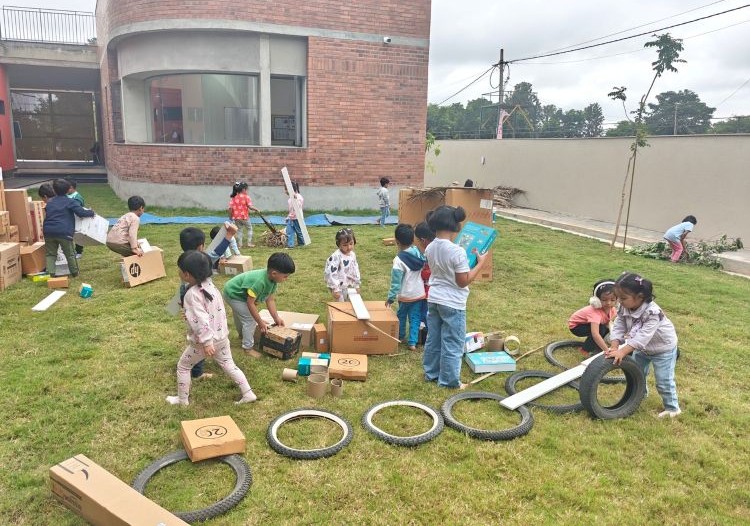
Anji Play is a unique, child-directed form of play that uses loose, locally sourced materials—such as cardboard boxes, wooden planks, drums, and tires—to create structures of their choosing. Educators observe but do not direct. Through group discussions, negotiation, sharing, and compromise, children learn important social and emotional skills such as empathy, cooperation, patience, and managing frustration. They also discover that joy comes from collaboration and creativity, even if their creations must be dismantled and rebuilt.
Outcomes:
Cognitive Development: Children develop critical thinking and problem-solving skills by actively engaging with materials and tasks.
Emotional Resilience: Facing small setbacks—whether in building towers, planting seeds, or constructing play structures—teaches children patience, perseverance, and adaptability.
Independence and Confidence: Experiential learning encourages children to make choices, take risks, and learn from mistakes without fear of failure.
Social Skills: Collaborative activities foster empathy, communication, and conflict-resolution abilities.
Positive Attitude toward Learning: Children learn that mistakes are opportunities for growth, creating a lifelong foundation for curiosity, confidence, and resilience.
Conclusion
At Eklavya, experiential learning goes beyond academics. By allowing children to actively explore, experiment, and engage with the world around them, we help them build mental and emotional resilience, independence, and collaborative skills. These experiences equip children with the tools to navigate challenges, adapt to change, and approach learning with curiosity and confidence—a foundation for lifelong success.
About Eklavya Early Years & Eklavya School, Bengaluru
Founded in 1997, Eklavya School today operates two campuses in Bengaluru — Eklavya Early Years at Kogilu for children aged 18 months to 6 years, and Eklavya School for Classes 1–12 following the Cambridge (IGCSE) curriculum. Established by educationist Sunil Handa and now managed by Siddharth and Niyati Handa, the institution is set amid a state-of-the-art 5-acre campus featuring facilities for sports, performing arts, and creative learning. Guided by the Sanskrit motto “स्वयंदर्शनं, स्वयंज्योतिः, स्वयंमार्गकरणम्” — Discover Yourself, Be Your Own Light, Make Your Own Path — Eklavya blends ancient wisdom with modern Montessori-inspired pedagogy, fostering holistic and experiential learning for every child.