

By Aastha Kanwar Gautam
A potato finds an unlikely place in NCERT’s Handbook for Science Teachers. One half of it has a lens mounted on it, while the other holds a piece of white paper. Place a candle on the table and move the paper around until the flame comes into focus, upside down. A few pages earlier, the same handbook recommends that neighbouring schools set aside half a day each week to use a shared laboratory. Of the two things a teacher would need to make this arrangement work, I suspect the potato would be the easier one to source.
On November 1, Education21 reported former School Education Secretary Sanjay Kumar asking how big an Indian school should be. In a village, the answer has much to do with what a school can borrow. A school small enough for children to walk to may still have access to a microscope and a teacher who knows how to use it. The National Education Policy (NEP) 2020 envisages precisely this model when it proposes that school complexes share laboratories, teachers and other resources.
In 2024–25, 51.7% of government schools with secondary sections had an integrated science laboratory. The figure rose to 52.2% in 2025–26. Both figures are from Table 7.23 of the Ministry of Education’s UDISE+ reports. I would be happy to see more schools move into that column. But I would still want to know when a child from the next village would get the opportunity to put her eye to the microscope in one of these laboratories.
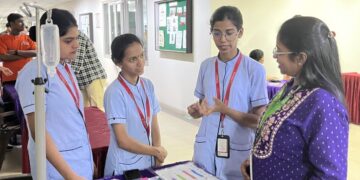
Bulandshahr in western Uttar Pradesh offers a useful clue from its primary and upper primary schools. A government account recorded 105 astronomy laboratories across 525 schools. Reporting from the district in 2022, Sheena Sachdeva noted that students and teachers from schools without laboratories could attend open science days roughly once every two weeks. Shivani Verma, who was in charge of the laboratory at Parvana, provided a figure worth considering alongside the official numbers. The laboratory could accommodate 25 to 30 students at a time, while a single class could have 60. That was before accounting for visiting students from another school.
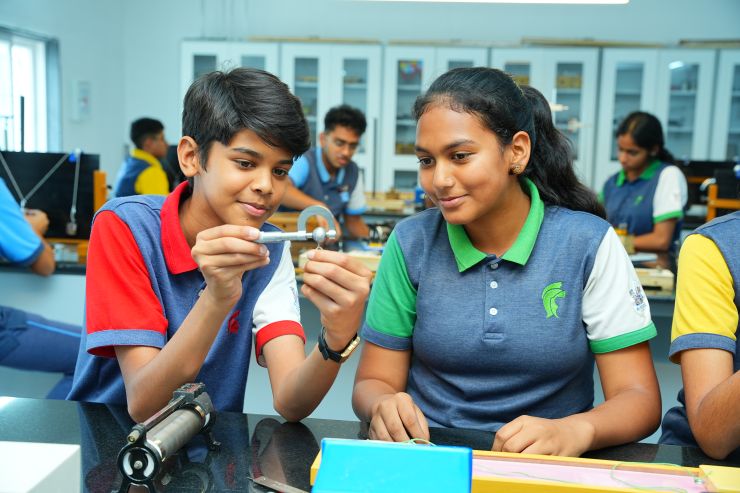
Try drawing up a timetable for four schools, including the host. Allocate 24 students from each Class X section. There are six working sets of apparatus, with students working in pairs. That means 12 students can undertake the practical at any one time. Each class will need two sittings, making eight sessions across the cluster. At 45 minutes each, that amounts to six hours of laboratory time every week for just these four classes.
Now add the time required to set up the apparatus, clear the benches and get visiting students back to their schools. Even those six hours will give every child a hands-on opportunity only if partners take turns. Otherwise, one pupil could spend the entire practical session taking absolutely perfect notes while someone else conducts the experiment.
I have a school in Jalesar, Etah district, Uttar Pradesh. If I were to offer its laboratory to three neighbouring schools, the easiest call I could make would be to invite them. The harder call would come a week before the pre-board examinations. My own science teacher needs an additional practical session. Another school has booked the room and paid for the bus. Who is in a position to tell me that my students must wait?
Unless we have agreed on the rules beforehand, the school holding the keys also holds the advantage of choosing the most convenient dates.
One coordinator, reporting to all four heads of schools, should be responsible for preparing the term-wise rota in consultation with the science teachers. Laboratory bookings would be entered into all four school timetables before other lessons fill the available slots. The host school’s classes would appear on the same schedule and follow the same rules. If two schools want the final slot before examinations, they could alternate first claim from one examination cycle to the next.
There should also be a spare double period every fortnight to accommodate cancelled visits. Whoever makes a change would enter the replacement date while the schedule is open. A smaller school could then plan around a confirmed Tuesday. It can do very little with an invitation to simply call on Monday night.
Then there are the other 12 children. While half the visiting class is working at the laboratory benches, their teacher could assist the remaining students with predictions, observations and interpretation in another room. The host school would provide the adult responsible for supervising the practical. The visiting head would arrange cover for the lesson that the accompanying teacher would otherwise have taken back at their own school.
I would give the coordinator a travel budget and responsibility for arranging transport so that every child can participate. If families are left to arrange and pay for their own journeys, household income will determine which children get an education in optics.
Some weeks, it may be the lens that needs to travel. NCERT’s handbook also suggests that equipment can be loaned to teachers for the part of the term when their classes require it. A box of lenses and screens could remain in a village school long enough for every pair of students to have another go. The bus, meanwhile, could be reserved for transporting a bank of microscopes and a teacher who can show beginners how to focus one.
The host school should also receive funds to replace equipment that breaks. If a cracked lens leads to correspondence about whose pupil dropped it, the safest thing for the next teacher to do would be to lock the cupboard.
The host school, too, stands to gain from sharing. Have a pair of students from one school record their estimate of a lens’s focal length. Let a pair from another school come in and check it. Two different readings for the same lens give both sets of students something to discuss and debate the next time they meet.
At the end of the term, I would review which visits each school had actually made, which ones had been missed and which children were still owed a session. One laboratory could be full every day while a neighbouring village school might have virtually no usage at all. That village may well be the one whose needs should guide the district’s decision about where the next laboratory is built.
I would also ask the pupil who had been keeping the notebook for a small favour. Could she get that upside-down flame back into focus? Give her the lens and let her move the paper. If her partner is the only one who knows what to do, then she gets the first turn next Tuesday.