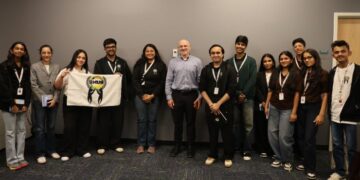


Introduced as a new component of vivo Ignite 4.0, the National Teacher Innovation Fellowship (NTIF) aims to strengthen the STEM education ecosystem by recognising teachers’ contributions in experiential learning, innovative pedagogy, problem-solving and inclusive classroom practices, vivo India, the smartphone brand, has announced 10 Teacher Innovation Fellows under the 4th edition of vivo Ignite 2026.
The fellowship received more than 200 applications from across India, with 30 educators progressing to the interview stage. Following a rigorous evaluation, 10 educators from 6 states, 1 UT and 10 districts were selected. The evaluation assessed four areas: Innovation in Teaching Practice; Inclusive and Adaptive Teaching; Real-World Impact and STEM Application; and Vision, Leadership and Scale.
The evaluation panel comprised nine experts and academicians from the education, STEM and innovation ecosystem, including representatives from IIT Madras Pravartak Technologies, Science Olympiad Foundation, among others.
Meet the NTI Fellows
R. Chandrasekaran | Tamil Nadu | Science & Mathematics
Runs the ‘Your Problem, Your Solution’ programme, encouraging tribal students in the Kolli Hills to develop solutions to challenges in their communities. His work has reached 10,000+ students and supported 72 student projects.
S Mani | Assam | Physics
Founded ‘Akashavidyalaya – Sky School of India’, taking astronomy beyond textbooks through solar studies, asteroid searches and instrument-building. His initiatives have reached 2,000+ students and members of the wider public across 11 schools.
Nitesh Kumar | Haryana | AI, Robotics & IoT
Uses a ‘Problem-to-Prototype’ approach that takes students through the innovation cycle from identifying a problem to developing solutions. His work has reached 10,000 students and 500 projects, with students participating in platforms including VEX World Championship and ISEF.
C. Manikyam Reddy | Tamil Nadu | Physics
Uses the ‘Enrich the Soil’ hands-on, experiential approach to make physics more engaging and application-oriented. His low-cost, 21st-century experiments challenge students to think and solve problems creatively, reaching over 1,000 students and mentoring around 20 projects.
Neeru Mittal | Delhi | STEM & Maker Education
Runs ‘Masti ki Prayogshala’, where students design, build and refine solutions to everyday problems. Her work has reached 4,000+ students, including 1,800 girls, and generated 250+ innovations.
Sadhana Kaushik | Uttar Pradesh | STEM / Atal Tinkering Lab
Developed an ‘Idea-to-Impact’ pipeline that enables students to identify problems, apply design thinking, prototype and refine solutions, helping embed innovation across the school.
Periyasamy P | Tamil Nadu | STEM, Robotics & AI
Focuses on STEM, robotics and AI-based learning, using hands-on approaches to encourage students to explore technology and problem-solving.
Lalit Mohan Sahu | Telangana | Science, Mathematics & Music
A 25-year teaching veteran who uses his ‘Rhythmic STEM’ approach to make science and mathematics more accessible through music. He also works with visually impaired students to support their participation in national and international platforms.
Nita Chandrashekhar Javale | Maharashtra | Computer Science & Atal Tinkering Lab
Combines computer science and Atal Tinkering Lab-based learning to create opportunities for students to explore technology through hands-on innovation.
Ekta Sharma | Uttar Pradesh | Science & Physics
Uses experiential approaches in science and physics to encourage curiosity, experimentation and application-based learning.
Geetaj Channana, Chief Corporate Communications Officer, vivo India, said, “Teachers play a critical role in shaping how students experience innovation; encouraging them to question, experiment and apply their learning to real-world challenges. Through the National Teacher Innovation Fellowship, we wanted to honour and acknowledge educators who are creating such learning environments and enabling students to think beyond the classroom. The diversity of the 10 fellows and the approaches they have developed across different classroom contexts demonstrate that innovation does not have to be limited by resources or geography. By recognising and celebrating these educators, vivo Ignite aims to contribute to a stronger culture of experiential and inclusive learning, while creating a ripple effect that can inspire many more young innovators.”