


• ECCE
  • School Edu
  • Higher Edu
  • Edu Tech
  • Skills
  • Jobs
  • Advertise
  • Login
[t4b-ticker]
  • Home
  • Latest
  • Spotlight
  • Perspective
  • Interview
  • Videos
  • Events
  • Shop
  • Student Kiosk
No Result
View All Result
  • Home
  • Latest
  • Spotlight
  • Perspective
  • Interview
  • Videos
  • Events
  • Shop
  • Student Kiosk
No Result
View All Result
Education21
Home Perspective

AI vs the classroom: How Should Universities Redesign Assessment for the ChatGPT Generation?

Dr Alex Ezat Parnia, President and CEO, Florida Coastal University, argues that American universities must urgently overhaul their grading systems to address the pervasive use of generative tools among students. Since traditional take-home essays and unreliable detection software can no longer guarantee academic integrity, the text outlines a shift toward process-oriented assessments and oral examinations that value critical thinking over a polished final product. Ultimately, the source posits that higher education must move beyond prohibition to ensure a degree remains a credible indicator of a graduate's reasoning and professional readiness

education by education
September 26, 2026
in Perspective
0
AI vs the classroom: How Should Universities Redesign Assessment for the ChatGPT Generation?
0
SHARES
129
VIEWS
Share on FacebookShare on Twitter

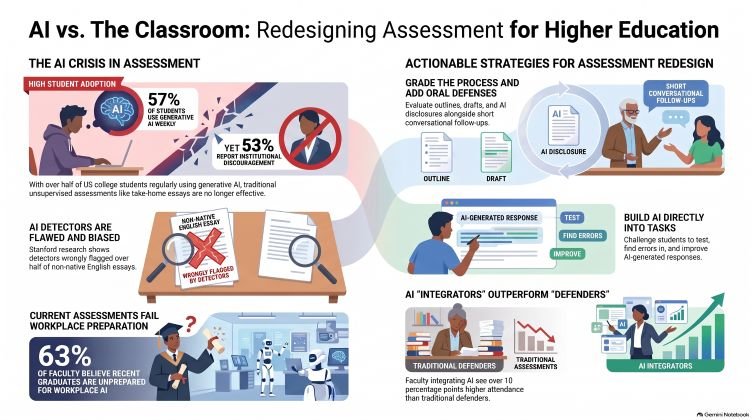
American college students have already made up their minds about AI. As per the research in The Lumina Foundation-Gallup 2026 State of Higher Education, 57% of US college students use generative tools in their coursework at least once a week, and about one in five do so every day. With roughly four in five universities overall relying on this tool, Stanford’s 2026 AI Index puts that figure even higher.

A number represented in the Gallup study surfaced something even more concerning for the university leaders: more than half of students (53%) say their school discourages or prohibits this kind of use. Moreover, students are basically relying on something they must avoid. That is a gap, and our assessments sit right in the middle of it.

Faculty feel this every day. In a survey of 1,057 faculty by the American Association of Colleges and Universities (AAC&U) and Elon University, 90% said these tools will weaken students’ critical thinking, 78% said cheating has increased since they arrived, and nearly three in four had personally dealt with an integrity case tied to their use. I share many of these worries. But we cannot keep pretending that the take-home essay still measures what it measured five years ago. As the academic integrity director at UC San Diego has argued, unsupervised written work is no longer reliable proof of learning.

Detection is not the answer

Many campuses first turned to AI detection software. This is declining but at a brighter note. Institutions such as Yale, Vanderbilt, Johns Hopkins and Indiana University are among the ones that have banned or discouraged these tools, leading to unreliability and bias against non-native English writers. A 2023 Stanford study found that popular detectors wrongly flagged more than half of essays written by non-native English speakers as machine-written. For any university that welcomes international students, a tool that unfairly accuses them isn’t protecting anyone, it’s putting them at risk. It is a liability.

Two roads for faculty

The Time for Class 2026 report found that 47% of faculty are now changing how they assess students because of AI. They tend to fall into two camps. “Defenders” are going back to controlled formats such as in-class exams and handwritten blue books. “Integrators” are redesigning assessment around AI through project work, repeated drafts, AI disclosure and asking students to critique what AI produces. The report found that Integrators see an attendance advantage of more than 10 percentage points over Defenders.

Supervised exams have their place, but they cannot be the whole strategy. Our graduates will not work in an exam hall. They will work alongside AI, and we should test whether they can do that well.
What redesign should look like

First, grade the process, not just the final product. Ask for outlines, drafts, revision notes and a short statement on how AI was used. The thinking a student does along the way is much harder to fake than a polished final page.

Second, bring back conversation. A 10-minute oral follow-up, where a student explains and defends their work, tells an instructor more than any detector ever could.

Third, build AI into the task instead of banning it. Ask students to test an AI answer, find its errors and improve it. The Digital Education Council’s 2026 global survey found that only 28% of students feel most of their assessments reflect the skills they will need in an AI-enabled workplace. In the US and Canada, 38% say they are not allowed to use AI in any assessment at all.

Fourth, is connecting assessment to real problems. As per the reports by Time for Class, a percentage of 61% of reports that they assign real-world projects, yet only 26% of students say they have completed one. That work needs to be more visible and more common.

Faculty cannot do this alone

None of this happens without support. Only 32% of institutions have an active AI policy, according to Time for Class, and just 17% of students in the US and Canada believe their instructors are well equipped to guide them on AI, the Digital Education Council found. Redesigning a course takes time, training and sometimes smaller classes. University leaders have to fund that, not just announce it.

For university leaders, the starting point should be simple. The question is no longer whether students use AI. It is whether a degree still shows that a graduate can think, judge and explain their reasoning. In the AAC&U and Elon survey, 63% of faculty said 2025 graduates were not ready for AI in the workplace. That is a warning the whole sector should take seriously.

This generation who is dependent on ChatGPT is not trying to skip learning. A major part of students reported to Gallup that their top reason for using AI is to understand difficult material. Our job is to design assessments that reward that curiosity, protect honest work and prepare students for the world they are actually entering.


  • Facebook
  • Twitter
  • Instagram
  • LinkedIn
  • RSS Feed
Previous Post

Ericsson and Telecom Sector Skill Council Launch CoE at Government ITI Govandi, Mumbai

Next Post

Heartfulness Education Trust and MDNIY Sign MoU for a 5-Year Partnership on Yoga awareness

education

education

Related Posts

Four schools, one science lab. Who gets a second chance?
Perspective

Four schools, one science lab. Who gets a second chance?

by education
November 22, 2026
From Degrees to Career-Ready Skills: What the AI Workplace Demands from Graduates
Perspective

From Degrees to Career-Ready Skills: What the AI Workplace Demands from Graduates

by education
November 13, 2026
National Education Day: More Questions Than Celebrations as Ad Hoc Governance Puts Education System in Limbo
Perspective

National Education Day: More Questions Than Celebrations as Ad Hoc Governance Puts Education System in Limbo

by education
November 11, 2026
Architecture Career: What Will Future Architects Actually Need to Learn?
Careerwise

Architecture Career: What Will Future Architects Actually Need to Learn?

by education
October 5, 2026
Education and Skilling Hold the Key to Meeting Growing Demand for Allied Health Professionals and Building Meaningful Careers
Careerwise

Education and Skilling Hold the Key to Meeting Growing Demand for Allied Health Professionals and Building Meaningful Careers

by education
September 30, 2026
Next Post
Heartfulness Education Trust and MDNIY Sign MoU for a 5-Year Partnership on Yoga awareness

Heartfulness Education Trust and MDNIY Sign MoU for a 5-Year Partnership on Yoga awareness

  • Facebook
  • Twitter
  • Instagram
  • LinkedIn
  • RSS Feed

Useful Announcements

  • All
  • Useful Announcements
Miranda House, NSDC and Eros AIVidya launch professional certificate courses for the AI and creator economy

Miranda House, NSDC and Eros AIVidya launch professional certificate courses for the AI and creator economy

November 24, 2026

Study Queensland of TIQ brings 8 education, skills and EdTech organisations to DIDAC India 2026

November 24, 2026

IIIT-Delhi to Host GastroSym2026 on December 12

November 24, 2026

Sarthak’s 13th National Conference on Disability in New Delhi on Nov 25

November 23, 2026

SRM School of Law Opens Admissions For 2027, Introduces Five New Future-Ready Programmes

November 23, 2026

UGC flags 32 fake universities; here is the list

November 23, 2026

Shiv Nadar School student releases documentary inspired by his autistic brother

November 22, 2026

NGO Brain Bristle announces audition of autistic and neurotypical actors aged 16 to 22 for its new play

November 22, 2026

TIET to host the Annual Techno-Cultural Festival ‘Saturnalia 2026’ from November 21–23

November 20, 2026

Eurogrip Tyres Invites Students and Creators to Participate in Torq Challenge 4.0 and Creator Challenge

November 18, 2026

Download current issue Not available

https://online.pubhtml5.com/jlyo/bxvr/

Monthly Magazine : Feb 2024

Interactive (Quizzes/Surveys)

Start Monthly Quiz
Education21

An initiative in continuation of Curriculum Magazine, Education21.in, is a platform for New India that aspires to be a valuable innovator, partner and collaborator for a just and sustainable world. Continuing with our steady and 360 degree coverage of education system and skills landscape, we are here more oriented towards learner community.

Useful Links

  • About us
  • Team
  • Contact
  • Editorial opportunities
  • Subscriptions
  • Job Opportunities
  • Features

Important Links

  • Blog
  • Archives
  • People
  • Careerwise
  • Resources
  • Downloadable
  • Old issues

Newsletter

  • Facebook
  • Twitter
  • Instagram
  • LinkedIn
  • RSS Feed

Copyright © 2020 All rights reserved. Education21.

No Result
View All Result
  • Home
  • Latest
  • Spotlight
  • Perspective
  • Interview
  • Videos
  • Events
  • Shop
  • Student Kiosk

Copyright © 2020 All rights reserved. Education21.

Welcome Back!

Login to your account below

Forgotten Password?

Create New Account!

Fill the forms bellow to register

All fields are required. Log In

Retrieve your password

Please enter your username or email address to reset your password.

Log In
Cleantalk Pixel