

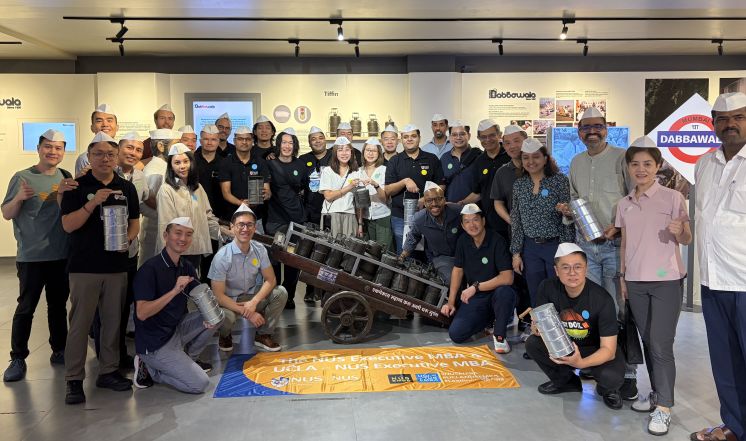
A cohort of 30 Executive MBA participants from the National University of Singapore (NUS) travelled to Mumbai last week as part of an experiential learning programme that turned the city itself into a classroom, taking participants from the process discipline of the city’s dabbawalas and the resourcefulness of Dharavi’s entrepreneurs to corporate leadership conversations and a live sports broadcasting operation.
The NUS Executive MBA India Programme, designed and facilitated by experiential learning company Immersion India, ran from September 6 to 12 across Mumbai and Bengaluru. The Mumbai leg took participants beyond conventional corporate visits to experience the city through contrasting lenses, from the process discipline of its dabbawalas and the resourcefulness of businesses in Dharavi to corporate interactions at Deloitte India and Jio World Centre and the scale of live sports broadcasting at JioStar.
Mumbai’s famous delivery network becomes a business lesson
The Mumbai experience began with a close look at one of the city’s most recognisable institutions, its dabbawalas. For the visiting executives, the interaction was an opportunity to examine how a highly decentralised network coordinates thousands of individual movements with consistency and discipline.
The learning then moved into a very different setting at Jio World Centre, where participants engaged in conversations around India’s evolving business environment. Interactions with business leaders and founders moved beyond success stories to discuss the practical realities of building organisations.
Dharavi: entrepreneurship outside the boardroom
The second day introduced participants to another side of Mumbai through Dharavi. Here, the cohort experienced a dense ecosystem of small businesses and entrepreneurial activity, seeing firsthand how enterprises operate within constraints, adapt to limited resources and create livelihoods in a complex urban environment.
From Dharavi, participants moved to Deloitte India for a company interaction and discussion around the broader macroeconomic and business environment.
Inside the world of live sports broadcasting
The Mumbai leg also took participants behind the scenes at JioStar, offering an inside perspective on the scale, technology and real-time decision-making involved in live sports broadcasting. Participants saw how multiple teams and processes come together to deliver live content to millions of viewers, including the pace at which production decisions and edits have to be made.
Understanding one city through different lenses
The dabbawalas demonstrated process discipline and coordination. Dharavi offered lessons in entrepreneurship, adaptability and resource efficiency. Deloitte India and the interactions at Jio World Centre brought participants into conversations around business, leadership and India’s evolving economy, while JioStar provided a window into technology, media and real-time execution at scale.
Making India the classroom
Immersion India designs customised, study-centric experiential learning programmes that enable students, executives, faculty and professionals to engage directly with India’s business landscape and its wider social and cultural context.
Following Mumbai, participants travelled to Bengaluru, where they experienced another side of India’s business story through technology, healthcare, advanced engineering and entrepreneurship, including visits to HiCal Technologies, Narayana Health and Tata Elxsi.
“India cannot really be understood through a presentation or a case study alone. You have to experience its companies, entrepreneurs, communities, contradictions and culture. Our idea is to make the country itself the classroom. Mumbai brings this idea alive in a fascinating way — you can move from the extraordinary process discipline of the dabbawalas to entrepreneurship in Dharavi, and then into some of India’s largest corporate and media environments, all within the same learning journey,” said Vineeth Thomas, Co-Founder, Immersion India.
For the NUS Executive MBA cohort, Mumbai therefore became more than a stop on an international study programme. It offered a firsthand view of how a city of extraordinary scale makes systems work, how entrepreneurs respond to constraints and how businesses operate across vastly different environments.