

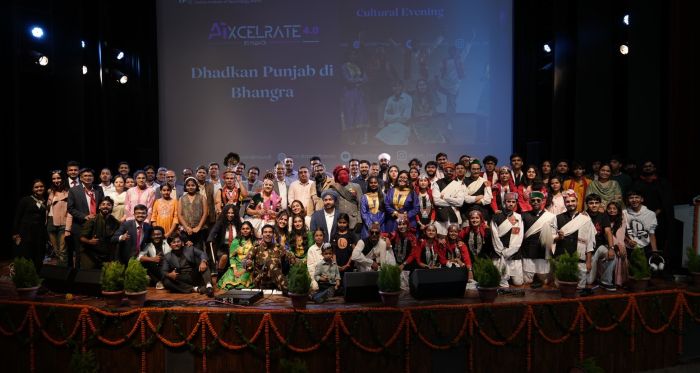
The School of Management, Indian Institute of Technology Mandi (IIT Mandi), held the 4th edition of its AiXcelrate 4.0, the flagship AI and leadership conclave, bringing together industry leaders, domain experts, practitioners, faculty members and students for two days of discussions on the changing relationship between artificial intelligence, leadership and business value on Sep 19-20.
Held at the IIT Mandi campus, the conclave was organised around the theme “Next Gen AI-Leadership: Beyond the Horizon to Monetizing AI.” The programme examined three interconnected transitions in contemporary AI adoption: moving from productivity and automation to strategic advantage, converting AI adoption into accelerated growth, and taking AI initiatives from pilot projects to sustainable and profitable scale.
A significant component of AiXcelrate 4.0 was the Industry Case Competition, sponsored and powered by 6D Technologies, which gave MBA and Integrated MBA students an opportunity to work on an industry-oriented business challenge. Teams were required to analyse the problem, develop recommendations and present their proposed solutions before a jury, combining strategic thinking, analytical reasoning and innovation.
The competition was designed around teams of four to five students working on a common industry challenge and defending their recommendations before a jury that included industry representatives.
Team Tactical Minds emerged as the winner of the AiXcelrate 4.0 Industry Case Competition, while The Case Solvers and The InsightX secured the first and second runner-up positions, respectively.
Commenting on the event, Prof. Anjan K. Swain, Chairperson, School of Management, IIT Mandi, highlighted the importance of what he described as the three S’s: scope, speed and scale in understanding the emerging relationship between AI and business.
“The business implications of AI increasingly need to be understood through three dimensions: scope, speed and scale. Its scope is expanding across organisational functions, the speed of technological change is accelerating, and organisations are confronting the challenge of scaling AI in ways that create genuine business value. AiXcelrate provides a platform to examine these questions by bringing management education into direct conversation with industry practice.”
The conclave also featured student presentations and mentoring interactions before concluding with the valedictory session. The programme was designed to enable sustained exchange between industry experience and management education rather than treating AI simply as a technological subject. The event schedule brought together panel discussions, mentoring, student engagement and industry-academia interaction across the two days.
The first day featured the panel “Moving from Productivity and Automation to Strategic Advantage: The AI Value Shift,” which examined whether gains in efficiency and automation are sufficient to produce sustainable competitive advantage and how organisations can move towards more strategic applications of AI.
The second day extended the discussion through two panels addressing the next stages of organisational AI maturity. During the second panel, Rohit Kilam, Chief Technology Officer at HDFC Life, reflected on the changing division of labour between humans and artificial intelligence, arguing that AI is likely to take over much of what is readily verifiable, while areas characterised by ambiguity and unverifiability will continue to require human judgement. “The verifiable will increasingly be taken over by AI, but the unverifiable will remain. That is where humans will continue to stay relevant,” he said, emphasising that organisations should focus on strengthening the distinctly human capacities for judgement, interpretation and decision-making that AI cannot simply automate.
The subsequent panel, “Moving from Pilot to Profit: Scaling AI,” turned attention to the challenges of taking promising AI experiments to enterprise-wide implementation. Discussions addressed data infrastructure, integration with existing systems, governance, workforce readiness, cost, human oversight and the need to assess which AI initiatives are capable of delivering sustainable returns at scale.