

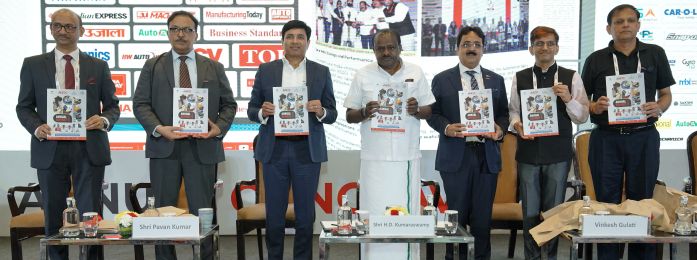
The 15th Annual Conclave 2026 of Automotive Skills Development Council (ASDC) in New Delhi on August 31, 2026 brought together government officials, automotive CEOs, manufacturers, component companies and academic institutions, reinforcing the need for closer collaboration between industry and the skilling ecosystem to build a workforce capable of supporting India’s ambitions as a global automotive and manufacturing hub.
Speaking at the conclave, Vinkesh Gulati, Chairperson, Automotive Skills Development Council (ASDC), said, “India’s automotive industry is at an important inflection point, with electric mobility, advanced manufacturing, AI and Industry 4.0 rapidly reshaping not only vehicles and factories, but also the skills required across the automotive value chain. Our focus at ASDC is to ensure that skilling evolves at the same pace as technology. The real measure of our success is not just the number of people trained, but how effectively those skills translate into employability, productivity and meaningful career opportunities.”
Mr Gulati also presented ASDC’s Performance Report for 2025–26, highlighting the Council’s expanding initiatives across industry partnerships, women’s participation, academia-industry collaboration, emerging technologies and employment-linked skilling. Highlighting ASDC’s increasing focus on future technologies and global capability building, he spoke about the development of seven EV skill labs across India and internationally, including facilities in Chennai, Vadodara and South Africa. These initiatives are aimed at providing hands-on exposure to emerging automotive technologies and creating a workforce equipped to meet both domestic and global industry requirements.
He added, “As India aspires to become a global automotive and mobility hub, our competitive advantage cannot come from manufacturing scale alone. It must also come from the quality of our talent. Future-ready vehicles will need a future-ready workforce, and India has the opportunity to become not only a global manufacturing hub, but also a global talent hub for the automotive industry.”
The one-day conclave held on the theme “Skilled Hands, Strong Nation: Building India’s Automotive Future,” was inaugurated by Shri H. D. Kumaraswamy, Union Minister of Heavy Industries, who underlined the importance of preparing India’s workforce for emerging technologies. The session also brought together Prof. (Dr.) Ashok Kumar Gaba, Executive Member – National Council for Vocational Education and Training (NCVET), and Mr. Pavan Kumar, Senior Vice President & Head – Sales, Customer Care & CX, Mahindra & Mahindra Ltd., Automotive Division, as Guests of Honour. Keynote address delivered by Mr. Mohan Reddy, General Manager, National Skill Development Corporation (NSDC).
Addressing the gathering, Shri H. D. Kumaraswamy, said, “India’s automotive sector is a powerful engine of growth, creating opportunities across engineering, electronics, components, logistics, software, services and employment. As India expands its manufacturing capabilities and global value-chain presence, developing a skilled workforce that meets global standards of quality, productivity, safety and innovation is critical.
He highlighted that the shift to electric mobility is creating new opportunities while increasing demand for skilled professionals in battery technology, high-voltage systems, power electronics and advanced diagnostics. Strengthening the link between education, skilling and employment must therefore remain a national priority. Through the Skill India Mission, the Government is committed to building a future-ready automotive workforce and positioning India as a global hub for skilled talent, contributing to the vision of Viksit Bharat @2047.”
A key highlight of the conclave was the emphasis on strengthening partnerships between the skilling ecosystem and industry. MOU exchanges were undertaken with Kia Motors India Private Limited; Kukje Business Solution Private Limited and Rossik East Europe SRL; Shell India; and Lucas India Service Limited.
The conclave featured two high-level industry panels addressing critical challenges across the automotive skills and employment ecosystem. The first panel, “The Last Mile Workforce: Building a Pipeline of Technicians and Entrepreneurs,” examined the need to create a robust pipeline of skilled technicians and entrepreneurs capable of supporting the industry’s expanding requirements. The second panel, “From Training to Employment: Strengthening the Skill-to-Industry Pipeline,” focused on strengthening the connection between training and actual employment opportunities, with discussions around industry requirements, job readiness and the need for greater alignment across the skill-to-employment value chain.