

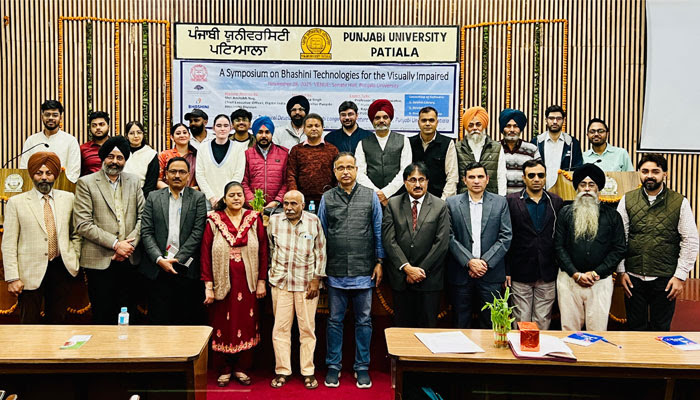
Developed at IIIT-H by researcher Krishna Tulsiyan under the guidance of Prof. CV Jawahar and Prof. Gurpreet Singh Lehal, Drishti Library is part of the Government of India–led Bhashini initiative, the national mission aimed at building AI-driven language technologies for all Indian languages. The project focuses on making higher-education textbooks available in Braille and audiobook formats, starting with Punjabi and expanding across languages and disciplines. The library was formally unveiled at a recent symposium on Language AI – for accessibility.
“Our objective is to create a library exclusively for the visually challenged and eventually in all Indian languages,” remarks Prof. Lehal. Unlike volunteer-driven audiobook efforts that often focus on general reading, Drishti’s emphasis is firmly academic. “Some libraries already exist, but this is the first initiative that is focused on providing purely educational content for the visually challenged”, he notes.
Bhashini’s language stack meets accessibility
Bhashini’s core mandate – to strengthen OCR, speech synthesis, and language tools for Indian languages – forms the technological backbone of Drishti. The library is built on OCR systems developed under a national consortium, aligned with Bhashini’s broader vision of inclusive, language-first digital public infrastructure. “We are mainly concerned with developing OCR for all Indian languages,” explains Prof. Lehal. “Any book in an Indian language can be scanned, proofread, converted, and finally made ready for Braille embossers or audio delivery.” The generated audio content is delivered through an audiobook reader application developed by the Product Lab at IIITH led by Prakash Yalla and Satish Kathirisetti along with Meghana Tatavolu , Afrin Sayed , Sairam Bonu, Akhila Vennigalla and Vidushi Garg.
The application is specifically designed to meet the needs of visually challenged users and provides an accessible and inclusive listening experience. Key features include adjustable playback speed, intuitive audio-based navigation controls, and accessibility-focused interface enhancements. Together, these features ensure effective and comfortable access to audiobooks for users with visual impairments.
Designed By Users
Blind schools, federations and the visually challenged themselves are actively shaping the platform. “They actually know what the needs are,” states Prof. Lehal. “We provide the technology. They give us the use cases and based on that, the software gets modified to suit them.” The platform currently supports audiobook generation using Indian-language text-to-speech, Braille-ready file creation, including pagination and formatting and PDF-to-Braille conversion, eliminating reliance on costly commercial software. “Popular Braille translators that are currently used are exorbitant. We’ll be providing all these facilities free of charge so blind schools don’t have to buy it,” says Prof. Lehal.
Challenges in Indian-language accessibility
Despite progress, challenges remain – especially in achieving natural-sounding speech. “For some languages, we have very good TTS,” notes Prof. Lehal. “But for Punjabi, we found that high-quality text-to-speech was still missing. That will improve with time.” Another unexpected learning curve was understanding how visually challenged users interact with technology. “Many of them are extremely comfortable using phones and computers,” observes Prof. CV Jawahar. “Their user interface needs are different from ours, and we’re learning from that.”
From classrooms to competitive exams
Although the initial focus is on undergraduate and postgraduate textbooks, Drishti’s scope is rapidly widening. At its launch – with visually challenged students in attendance – new demands surfaced. “Some students said they were preparing for UPSC examinations and asked if those books could also be made available,” recalls Prof. Lehal, adding, “That was never part of our original plan, but now we’re thinking in that direction too.”
A collaborative platform for the future
In keeping with Bhashini’s open, scalable philosophy, Drishti is being developed as a platform rather than a closed repository – one that allows volunteers, NGOs, and institutions to contribute content from anywhere. “We cannot centrally create content for all languages and all needs,” admits Prof. Jawahar. “So the idea is to provide a technology platform that others can use. Otherwise, it will never scale fast enough.”
Currently, the Drishti website hosts a limited number of audiobooks, accessible via secure login to address copyright concerns. Wider participation and content creation are now in progress. “The response from actual users was incredibly inspiring,” remarks Prof. Jawahar. “Their enthusiasm is what is driving this forward.”
As part of the Bhashini mission, the Drishti Library signals a crucial shift – where language technology is not just about translation or speech, but about educational equity and dignity of access for millions of visually challenged learners across India.